Showing posts with label Fiona Moore. Show all posts

Thursday, 6 December 2018

December 2018: Is Poetry a Winter Sport?

Poets avoiding summer...

It could be said autumn and winter are the poetry seasons. Do I even have to mention Keats and autumn? There's something about the crispness of the air and the clichéd and adjective-ridden fiery, glowing, crimson, burnished, twisted, bewitching, fading leaves that also contributes to this poetic mood. I know this for a fact not only because of several ill-starred Romantic poets, but also from opinions on social media. Therefore it’s obviously a gospel truth.

Which could be one of the reasons I’m blogging again, either that or I’m trying to avoid a stack of marking. December is here and for many poets and readers that means thinking about their favourite books of the year. What year you may ask? I haven't blogged since January. If only some of the politicians of the world had kept a low profile...

This summer in England was one of the hottest I could remember. During the summer months I find my brain doesn’t engage with writing poetry very well. I tend to write critical pieces and reviews, but not so many creative pieces. Also summer is  holiday time so we’re busy travelling and outdoors a lot. There were a few interesting things poetry wise. I had a poem in the In Transit: Poems of Travel anthology published by The Emma Press and edited by Sarah Jackson and Tim Youngs. In July I read a poem of mine at the Magma launch in London and happened to get swept up in the Anti-Trump demonstrations, so it was an eventful day all round.  Here is a link to my Magma poem

My new poetry 'thing' is form, either my own designs or strangely the more conventional approaches to form. I am having a go at the sonnet form today, in particular the Petrarchan variety. I think I need the sense of 'playing' again with form and line. 
This is odd because normally I can't be doing with full rhyme (see what I did there). It might not get anywhere, who cares. It's been interesting having a go. There are some poems building up and, rather like the average cat, they're standing at the open door not sure whether to go out in the world or stay inside.


Also I got a bit overwhelmed by the constant influx of social media into my daily life. Someone once rightly said the effect of too much social media is like being trapped in a cement mixer. I've not been as active for sanity. 

I'll end with a few wintry lines from Fiona Moore's poem 'Overwinter' from her collection The Distal Point published by HappenStance Press.  I love how she manages to darn well capture that odd time of year, now coming up, when dark eats up the day. It could be grim but her tone is optimistic. It's hopeful:


Nothing will happen for a while, nothing - 

and I need such certainty: to become
embedded deep within this season
when dark overplaits the day's pale strand.
Change may come while nothing seems to change.
I know it will take a long time.


Monday, 14 December 2015

November & December 2015: Reading, Readings and the Common Cold

I have a cold today and am at home feeling lousy. I probably shouldn't be blogging, but I felt it had been a long while since the last post. There is some cheering news for the blog though, in the form of Matthew Stewart naming Commonplace as one of his selections for best poetry blog. There are a great many listed on site and you can read the post here for interesting things to discover. He makes a good point about Commonplace being something of a journal. That has been quite a regular feature and perhaps there will be more themed entries at a later date, but today it's diary time. I feel like I need to catch up today.

Recently I've done quite a few readings. Starting in October with at 'Writers in the Bath' organised by Cora Greenhill. No fear, it's a venue called 'The Bath,' not an actual one. That reading was with Roy Marshall and Jo Bell. Then the was the Vanguard night of Poetry in Camberwell, London in November, organised by Richard Skinner. I read with Cathy Galvin, Sophie Herxheimer, Keith Hutson, Martin Malone and Rob Harper. As with the other London reading in September, I had to dash off for the train, which I wasn't happy about. I knew the other readers would be special and it was a great night. Both readings were indicative of the kind of enthused, supportive and warm audiences you have at poetry readings. At the Vanguard reading there was a lady in the audience called Evalyn Lee who was drawing some amazing pictures of all the readers. I am sharing one of me below:


Drawing by Evalyn Lee, 19/11/15

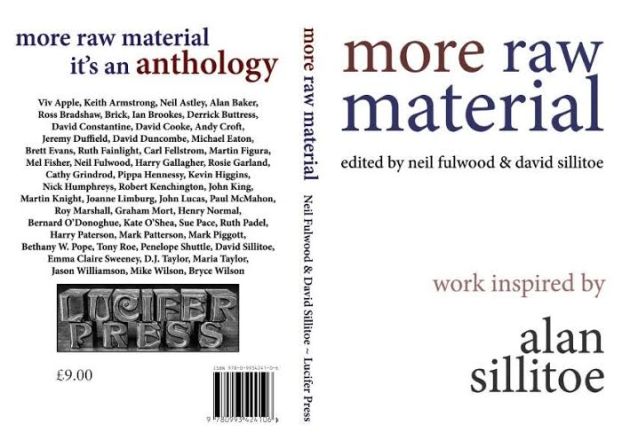
More recently I did a short reading as part of the launch of More Raw Material, an anthology of writing inspired by Nottingham writer Alan Sillitoe. The book is edited by Neil Fulwood and David Sillitoe.

Sillitoe1

I was really struck by Neil and David's enthusiasm on the night. Five Leaves Bookshop in Nottingham was packed. It's a really enjoyable read and the book aims to raise funds for the Alan Sillitoe Memorial Fund. Some more details here. In preparation for the night, I re-read my copy of Sillitoe's short stories in The Loneliness of the Long Distance Runner.  The Nottingham literary scene is on a bit of a roll at the moment having been chosen for UNESCO's City of Literature. Well done.

Talking of the East Midlands, another very important anthology from the area is currently out: Over Land, Over Sea: Poems for those Seeking Refuge, edited by Kathy Bell, Emma Lee and Siobhan Logan.

 Poets4Refugees-Over_Land_Over_Sea

Proceeds from sales of the book will be shared between three charities: Médecins Sans Frontières, Leicester City of Sanctuary and Nottingham Refugee Forum. The book is obviously a response to the terrible events of the last few months. So far they've sold hundreds of copies. There are 102 poems and contributions form the following poets: Alan Baker, Kathleen Bell, A.C. Clarke, Kerry Featherstone, Chrissie Gittins, Mark Goodwin, Tania Hershman, Siobhan Logan, Emma Lee, Carol Leeming, Joanne Limburg, Aoife Mannix, Roy Marshall, Hubert Moore, Thomas Orszag-Lund, Simon Perril, Sheenagh Pugh, Mahendra Solanki, Maria Taylor, Rory Waterman, Gregory Woods, and Siobhan Logan. More information and copies of the book are available here. The editors have worked incrediby hard to turn the book around in little over two months from subs to the final print.

Finally - and this is where my cold could be a problem -  Mr. Commonplace aka Jonathan Taylor has a fabulous new novel out with Salt called 'Melissa.' There's already been a Leicester launch and there's one at Five Leaves Bookshop on Wednesday night from 7pm. I'm meant to be reading with Jonathan, but I'm hoping the cold will be gone by then. Here's some more info on the book here. I obviously know it quite well having lived in the same house where it was written and having seen various drafts. It's quite odd hearing Jonathan read it for public audiences when I read drafts of it at the artwork stage, but it's all good. I sense a veering into prose for this poetry blog, so I should add he also has a poem in the current Rialto too.


I've also been editing reviews for Under the Radar this month. It's actually a challenge and a reward. More on that when the next issue comes out. Also, a few poetry books to recommend. I hope to write some longer pieces soon, but books currently by the bed (a great honour) among others include: Night Letter (pamphlet) by Fiona Moore and The Whole & Rain-domed Universe by Colette Bryce. It's also good to see Daniel Sluman's second collection The Terrible out, which I was also lucky to see in its earlier drafts.

                                                     ************************

Finally a few thoughts on the Aldeburgh Poetry Festival. Since writing my last entry things are not looking good for The Poetry Trust, who run the festival and the event may only take place on a reduced and much smaller scale next year.In fact, the Trust's offices are no more and up for rent. I'm glad I went to Aldeburgh for two years running before this news. I'm really sorry about it. I'm glad though that my write-up has been used among other blog posts to support and promote the festival. Judging by the stats there's been a lot of interest. It would be such an awful waste if the festival lost all it's funding. It was a genuinely special thing to attend. There is a very touching guest post by Naomi Jaffa on Anthony Wilson's blog which you can read here.


Now back to bed and some paracetamol...

Sunday, 18 August 2013

What I Read On My Holidays...


Summer is usually reading time. For some it’s writing time, but I seem to do an awful lot of reading in the holidays; sometimes for reviews, sometimes when someone wants me to cast an editorial eye over something and sometimes even for pleasure. As for the writing I’m working on a few things, including the odd commission which I’ll say more about later.

My summer reading kicked off with a novel, John McGregor’s ‘If nobody speaks of remarkable things.’  It was all about an unremarkable street full of apparently unremarkable people, but there was a type of spell cast over all of them by the narrator. The ending especially was particularly gripping, but I probably shouldn’t talk much about that. As a side note, I like the book’s title. I like the way it sounds like an unfinished sentence. Another book to stay with me for a long time I think.


Next was Matt Merritt’s ‘The Elephant Tests.’ Having heard so many out loud, many of the poems felt very familiar, but I think that’s part of the skill of Matt’s work. The tone is familiar, almost confiding, but then the poet slips in a line, word or image which surprises and engages. There were some fabulous poems, including a longer one called ‘Ravens, Newborough Warren’ which appealed to me for its repeated line, ‘don’t be surprised if nothing happens.’ There were so many poems I could talk about but you can find out more here on the Nine Arches Press website. Earlier in the year we read together in Leeds and I was struck by the way Matt’s work really connects with an audience and heartened to see lots of books sold and going to good homes.

I’m including a poem from the book on the blog. It’s called ‘Azul.’ Considering I was abroad visiting my family as the time of reading, there was something in the vividness of the images that made me look up the skies and consider the ‘inadequacy’ of the words for blue. Ironic perhaps, there’s so much vitality in Matt’s presentation of the colour:

Azul

The sky high and no limit at all.
Each time, the mind’s migration. Sky-blue
sky. Enough to understand
You live on an island. The distance

At once turquoise, cobalt, cyan. Blue
As eyes exactly açor-blue. Shades of the hawk,
Caught on its amphetamine rush against
A sea-blue sea. Caldeira-blue, hydrangea blue,

And the lights coming on
on ships in the harbor.
A navy-blue, and now the night,
Lunar-blue, celeste-blue, shot through

with silver-blue star wounds
that will only heal to a horizon
blue with mountains behind heat haze
or slipping in and out of cloud, like

The piecing together of dreams,
Like realising there are other
islands, and the inadequacy
of the word for blue.

I took a few Happenstance pamphlets with me as well. Recently, I've been reading quite a lot from the press. Fiona Moore’s ‘The Only Reason for Time’ is a pamphlet I’d really recommend, I've been re-reading many of the poems. Many of them deal with the loss of a partner and this is done in a way which is moving, incisive and elegant. The pamphlet initially sold out, but I'm happy to report it's back in stock and be ordered here, so do get hold of a copy before they sell out again. Here's a remarkable poem from the collection called 'The Shirt.' In earlier drafts of this entry I included a link to the poem, but I've found that the site didn't always work on my computer, so I've typed it up: 

The Shirt

I didn't find it for months, your shirt
bundled into a corner of the airing cupboard.
I shook it out. It had been cut
with long cuts, all the way up the sleeves
and up the front, so it looked like a plan
of something about to be put together.
They must have had to work so fast to 
save you there was no time to unbutton it.
An office shirt, because that's where 
it happened. The thin stripes slashed through - 
terrifying, unprecedented - a reminder
of everything I wanted to forget.
I'd washed it afterwards, not knowing what to do
with it, or that in three weeks the same thing 
would happen to another shirt, a favourite,
dull cotton whose thick weave made it look 
as if all the pink shell-grains of sand 
had come together on one beach, 
a shirt for a gentle hug; and from on,
nothing happened that we would forget.

Another special and very different pamphlet was Mark Halliday’s ‘No Panic Here.’ It was recommended to me and I finally found out that the quirky, conversational poetry I’m often drawn to has a name, it’s called ‘ultra talk,’ a phrase Halliday coined himself. It’s quite different in style to a lot of things you’d find in magazines. One bright, peachy Cypriot morning, before anyone else was up, I opened up the pamphlet and this was the first poem I read:

Numerous Swans

So many brooding swans like floating inkstains on a lake of
slender wakefulness. Really a lot, like more than fifty.
Across the narrow hips of the lake they glide,
dark and darkling, their plumes so silent yet not at all sleepy

Nor is the lake itself sleepy; it is a body of water
deep and liquid with liquidity of apprehension
as I turn my phrase like a dinghy and the oars clack
in the melancholy oarlocks. Ah there they pass again,

so many, I had not figured th’ineffable had bred so many,
possibly as many as sixty, swans the inky colour of night,
they are my thoughts if you haven’t twigged to that already,
and I delight to see them there, slender and brooding

and feathery and light and pensive and dark upon the lake of moi.

Mark Halliday 

Click here for more info about the poet himself and the pamphlet from Happenstance.


I like what this poem does and the humour achieved with the swans that become more numerous in the final stanza. The repetitions and images satisfied. The poem offers a way of stepping out of a poem, in the same way you might watch an old cartoon and Bugs Bunny may have stepped out the frame and be talking directly to the audience. Another way of putting this, I suppose may be Brechtian, but that's an overused term. On the other hand, poetry as theatre? Something to think about.

It's still August, there's still more reading to be done. I've got a few review copies to get stuck into. There's also the magazines of course, the most recent issues of 'Under the Radar' and 'The North' have been top reading material. I'm also open to any other recommendations.