Monday, 10 February 2014

Questions....


Hi, a few weeks ago. I was asked to take part in a blogging tag tour by the wonderful poet Kim Moore. The questions looked interesting and hopefully the answers might be of some interest to you. Her blog can be found by clicking here.

1) What am I working on?

I always seem to write poems with not a great deal of conscious thought as to how they might link up or might fit in a collection. Sometimes I wonder how other poets seem to have these big ideas that result in the ‘cohesive’ collection, with all the poems in the book following similar paths. Maybe that will come? I love having a constructive poem to work on, but feel a bit at sea when I haven’t written for a while or working on something that I think is going nowhere. So I’m not working on a ‘book’ as such, just writing individual poems. At some point many of these poems will probably find themselves in a manuscript. I like the idea of not having a map.

2) How does my work differ from others of its genre?

It does and it doesn’t, part of me thinks ‘there is nothing new under the sun.’ Surely everything is influenced by something or has some echo from the past? My aim has to be to make “it work,’” which, “might be more revolutionary an objective than making it new” as David Morley once wrote. I don’t compare myself to other poets in that way, although there are plenty I’ve learnt from. Rather than differing from ‘others’ I like to differ from what I think of as my own style of writing now and then. Hence the ‘Poetry Bingo’ card set published by HappenStance and poems about topics that take me out of my comfort zone; writing about sex and science matters for instance. I’ve just finished a poem on the French astronomer La Caille. That’s very different for me!

3) Why do I write what I do? 

Erm...I don’t quite get this question. Actually if it means do you write about what you do, I’d be horrified if I actually did what I did in my own poems! Some of them are partly biographical, but if I were courting mermen and drinking from the rivers of the Hades it would be a worry! I don’t really write ‘what I do’, poetry is about real life through a hall of mirrors. For me, it’s about putting unusual thoughts into some sort of coherent shape and being concerned about the sound as much as the content.

4) How does your writing process work?

There are quite a few ways. Firstly, reading. If I’m stuck, I’ll read. I’ll read poetry that I love or new poetry I’m excited about reading. I spend lots of money on books! I’ll then pick up a pen and see where it takes me. There’s also nothing better than a good, immersive novel. The thing is, however, I don’t feel inclined to write poetry when I’m lost in a novel! That comes after.
Sometimes I just have an idea and I have to get it down on paper. This can happen at any time, I might be doing something completely different: swimming, walking, admin chores, and then bang! It has to be done, people sometimes say, as did the late Seamus Heaney, that they feel ‘commanded’ to write a poem. It’s sounds a bit grandiose, but it’s so special when that happens and feels much more natural and unconsciously done. You’re not drafting the hell out of a poem which doesn’t feel like being written. I think there should be an imperative for writing a poem, otherwise it won’t work. Also, I have no idea where a poem might be heading when I start to draft it. My notebook will be full of rough drafts and then I’ll underline the things that work and cut out what doesn’t. The only workshops I go to are the ones held in Sheffield by The Poetry Business, so I have lots of stream of consciousness poems in books waiting to be edited.

I feel sorry for the abandoned poems, the ones that Sylvia Plath refers to as the malformed ones. There are so many now, they had such good intentions, poor things. Sometimes, they manage to creep out of the drawer.

Next week it's Jayne Stanton's turn! Jayne has been published widely in many magazines and is an great poetry enthusiast! Not only is she a poet, but she's also a teacher and musician. She lives, works and writes in LeicestershireHer debut pamphlet is forthcoming from Soundswrite Press in autumn 2014. Her blog can be found here. 

Monday, 3 February 2014

Sticks

When my twins started school in 2013 they developed a habit of getting very attached to the most bizarre objects, especially when out and about. Our walk to school takes us down an alleyway (or a jitty if you're from Leics) which leads on to a patch of green with a large willow tree. There's a busy crossing next, but before that bit we get a little bit of nature.  There are some railings next to allotments on one side of the jitty. Back in late summer 2013 this became the ideal hiding place for my daughter's collection of sticks. We'd go to school in the morning and she'd leave a stick in a special place in the railings and feel very pleased when we walked home in the afternoon when she found the stick waiting for her. The sticks changed everyday and eventually formed a pile in the front garden, but the point was that the same stick had to be retrieved at the end of the day. A sense of security, I suppose.

Of course one day the stick wasn't to be found. That provoked a lot of tears. I had to try and see the world from a 4 year old's perspective and think what it was to lose something which gave you a sense of place and security. I'm sure starting school had a lot to do with that. Eventually sticks became old hat and I had the idea of writing a poem about the event. It went through many drafts, at one point there was a cherry tree, but then there were too many trees! Tinkering ensued. I did an online course and this was one of the poems I submitted for feedback. Thank you Liz Berry and the other students! The poem is now available in 'Acumen 78' although there was a problem with the printing and the last 2 lines were lost from the page. The editor, Patricia Oxley, has kindly published the poem online so you can read it in full here. If you're reading this post months after it's been posted, then scroll down and you'll find it eventually. It's only been relatively recently that I've started writing about my children, so this is quite personal territory for me.

Tuesday, 21 January 2014

Being Human


'Being Human,' Embrace Arts, Leicester.
Saturday 18th January

I had absolutely no idea what to expect from the stage production of 'Being Human' when I went to see the show in Leicester last Saturday. I knew it was a dramatic production of the ever popular 'Being Human' poetry anthology ed. by Neil Astley and published by Bloodaxe. I did wonder how the show would be structured - would there be a narrative? Would there be some kind of thread weaving the poems together? In a way I don't want to tell you and therefore spoil the sense of anticipation you might have. After all how do you perform a book of poetry?

Before the show itself I was kindly invited to take part in a pre-performance talk and the concept of performing poetry. It was co-hosted with the show's producer Jonathan Davidson and the director Steve Byrne. There was a great deal of lively discussion about the topic and I realised that there's quite a difference between the idea of actors reciting poems and performing them. In terms of performing a poem, why shouldn't it be performed? I know there was some debate at the Forward Prizes about actors reading out poems, but 'Being Human' isn't about reading out poetry, it's about the actors inhabiting the poem, making it real living and breathing through every word. If you know anyone who wants an introduction to contemporary poetry then they should go to this show. If you read a lot of poetry you should still go to this show! You will not have experienced poetry like this. The performances by the actors, Barra Collins, Elinor Middleton and Rochi Rampal, were superb and utterly right for the poems.

The play itself is 90 minutes of poetry and nothing else but poetry. There are a few simple props, but other than that it's the actors who perform the poems and allow us, an an audience, to be part of them. What I found most intriguing was the ordering of the poems in the play. Poems have been selected from the anthology so they tell their own story of what it is to be human, from love, parenthood, death, war, ageing and the adventure of being alive. The performances and the poems are alive and utterly convincing. It is good to be reminded of the creative scope of poetry and of how it can touch a reader and an audience. It's also good to be reminded that poetry is all about the poems themselves and how they act as a little truthful world of their own. Here's a poem which to me does that reminding, and it's from the first poem in the show, 'Ars Poetica #100: I Believe' by Elizabeth Alexander:

Poetry (here I hear myself loudest)
is the human voice,

and are we not of interest to each other?

Friday, 17 January 2014

Poetry, Sex, Penguins, Cake

Hi, thought that title might wake you up! Ok, this is the first blog post of the year and I think we're all beyond resolutions and have returned back to our inevitable selves. Personally, I don't bother with them on New Year's Day, I make them up and give them up all year round. As I said in a previous post, life doesn't adhere to calendars. Things started last year spill into this one. In my case around July last year I received an email saying a poem I'd submitted had been accepted for a Penguin anthology, 'The Poetry of Sex' edited by Sophie Hannah. Didn't quite believe it. There were follow-up emails in the autumn which made me believe a bit more, but the other day this landed on the mat:


Now it's starting to feel real. This book is going to be on shelves in bookshops very soon, at the end of January in fact. Here's something from the book's synopsis:

It's hard to imagine a more fruitful subject for poets than sex, in all its glorious manifestations: from desire and hope, through disappointment and confusion, to conclusion and consequence. And little has changed over the centuries, as Sophie Hannah's anthology vividly demonstrates, from Catullus pleading with Lesbos to Walt Whitman singing the body electric. Moods and attitudes may vary but the drive persists as does the desire to write about it.
Sophie Hannah's selection ranges from ancient Rome to modern New York, from gay to straight, but her principle has been to go low on the sugar and high on the excitement. The result is a raucous, highly enjoyable anthology.
From Shakespeare to Carol Ann Duffy, this book is essential reading for poetry lovers and romantics everywhere.

My own contribution is a slightly eccentric piece. Obviously it's very exciting and rather surreal being in a book with so many well-known poets. I didn't set out to become a sort of poetic Virginia Johnson, but you can never predict what you'll write about next...

Let's think about Cake now. I also have a poem in the long awaited issue 5 of Cake.


Here is a copy of the front cover of the magazine in all its coffee coloured glory. The editors are Martha Sprackland, Andrew McMillan and Fin Jackson and they've done a fine job.

So there you go, January. In the time taken to write this post a rejection letter arrived on the mat. One I didn't want. So there you go, swings and roundabouts. So although I have no new year's resolutions I have some idea what to expect. Let's see what the rest of the year will bring...let's keep going, everyone.


It's hard to imagine a more fruitful subject for poets than sex, in all its glorious manifestations: from desire and hope, through disappointment and confusion, to conclusion and consequence. And little has changed over the centuries, as Sophie Hannah's anthology vividly demonstrates, from Catullus pleading with Lesbos to Walt Whitman singing the body electric. Moods and attitudes may vary but the drive persists as does the desire to write about it.Sophie Hannah's selection ranges from ancient Rome to modern New York, from gay to straight, but her principle has been to go low on the sugar and high on the excitement. The result is a raucous, highly enjoyable anthology.From Shakespeare to Carol Ann Duffy, this book is essential reading for poetry lovers and romantics everywhere. It is a perfect counterpart to the The New Penguin Book of Love Poetry and a wonderful companion to Sophie Hannah's own Selected Poems.

Read more at http://www.penguin.co.uk/nf/Book/BookDisplay/0,,9780670921836,00.html#swZFeYPRlsLcJiv7.99
It's hard to imagine a more fruitful subject for poets than sex, in all its glorious manifestations: from desire and hope, through disappointment and confusion, to conclusion and consequence. And little has changed over the centuries, as Sophie Hannah's anthology vividly demonstrates, from Catullus pleading with Lesbos to Walt Whitman singing the body electric. Moods and attitudes may vary but the drive persists as does the desire to write about it.Sophie Hannah's selection ranges from ancient Rome to modern New York, from gay to straight, but her principle has been to go low on the sugar and high on the excitement. The result is a raucous, highly enjoyable anthology.From Shakespeare to Carol Ann Duffy, this book is essential reading for poetry lovers and romantics everywhere. It is a perfect counterpart to the The New Penguin Book of Love Poetry and a wonderful companion to Sophie Hannah's own Selected Poems.

Read more at http://www.penguin.co.uk/nf/Book/BookDisplay/0,,9780670921836,00.html#swZFeYPRlsLcJiv7.99
It's hard to imagine a more fruitful subject for poets than sex, in all its glorious manifestations: from desire and hope, through disappointment and confusion, to conclusion and consequence. And little has changed over the centuries, as Sophie Hannah's anthology vividly demonstrates, from Catullus pleading with Lesbos to Walt Whitman singing the body electric. Moods and attitudes may vary but the drive persists as does the desire to write about it.Sophie Hannah's selection ranges from ancient Rome to modern New York, from gay to straight, but her principle has been to go low on the sugar and high on the excitement. The result is a raucous, highly enjoyable anthology.From Shakespeare to Carol Ann Duffy, this book is essential reading for poetry lovers and romantics everywhere. It is a perfect counterpart to the The New Penguin Book of Love Poetry and a wonderful companion to Sophie Hannah's own Selected Poems.

Read more at http://www.penguin.co.uk/nf/Book/BookDisplay/0,,9780670921836,00.html#swZFeYPRlsLcJiv7.99

Saturday, 28 December 2013

Sun Bathing in December

At this time of year it's customary for blogger to round-up their books of the year. I find that a hard thing to do in terms of poetry. Some of the poetry I've come across this year was published before 2013, this would include work by Mark Halliday (have blogged about him before) and two stunning books by Catherine Smith: 'Lip' and 'The Butcher's Hands.' I read those two from cover to cover and was struck by the range of subject matter and Smith's ability to write about darker (and therefore rather interesting) aspects of human psyche. I'm looking forward to getting a copy of her latest book, 'Otherwhere.' What an intriguing title. Another non-2013 favourite, also published by the fabulous Smith/Doorstop press was Carole Bromley's 'A Guided Tour of the Ice House.' That book sustained me through a evening of cancelled trains on the way home from Sheffield. Bromley's work is a pleasure to read: clear-sighted, direct and utterly engaging. Poems like 'In Another Life' and 'The Lovers' and 'South Bank and Eston Rotary Club, 1951' really grabbed me and there was so much in the book to curl up into. Funny, sad, wry, honest. I have the book by the bed and keep returning to it, that's a big mark of admiration for me.

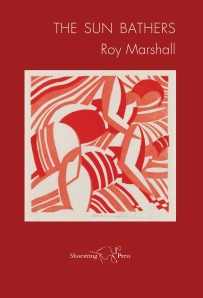
So, I'm not done with 2013 yet. I have no doubt that 2014's blog posts will have some focus on things published this year. There's one book I'm going to focus on though and that's Roy Marshall's 'The Sun Bathers' published by Shoestring. Regular readers of this blog will know I have praised Roy's work over the last couple of years. In 2012 his pamphlet 'Gopagilla' was published as a part of a series of our Crystal pamphlets and it was packed with strong, memorable pieces, many of which can be found in 'The Sun Bathers.'

Front Cover


A first collection from Roy is a very huge deal, especially when you've seen a poet's work develop and grow over time. I know it's not just me though. When I read at Beeston Poets in November with Roy a couple of things struck me. Firstly, I noticed the audience was hanging on every word in his poetry and we experienced 20 minutes of lyric power tempered with a plain-spokeness which made the poetry immediate. One of the first times I heard Roy read was at Leicester's WORD! back in 2010, and I heard a remarkable poem called 'No Signals Available' which made me sit up and take notice. That poem is also in the book I'm happy to say. When I read 'The Sun Bathers' many of the poems were familiar to me, not least because they've appeared in a plethora of magazines but also because I've been lucky enough to have seen them at the drafting stage as well. Don't just take my word for it, at the Beeston reading an audience member requested a poem, which shows to me that readers form attachments with these poems. A great sign to my mind. You can find details of how to track down a copy here.

It's hard to pick an individual poem to share with you as there are so many notable poems. Many of these you can find on-line, but you should of course buy the book! My favourites include the 'Leonardo' sequence, 'Presence', 'Rose,' 'A Western Australian Piano Graveyard,' 'Relic' - this list could be longer, you get the picture. These are well-formed poems with a personal edge. They speak to you. As I said many of Roy's poems are on-line, so to avoid overlaps I've chosen 'Cimetero' which draws on the poet's Italian heritage. There are some sumptuous and evocative words and images, 'gellateria' honey heat and scent of rosemary, the child's innocence at the father 'who'll live forever' and the understated sinister sense of death and corporeal decay, colours 'deepening from terracotta to crimson.'

Cimetero

The gate kept a world out: scooters humming
along the road that ran down to the lake,
gellateria and monument.

Lizards froze, slipped into cracks, past photographs
set in granite, chrysanthemums on marble beds,
so different from the grassed churchyard at home.

I loved the honey heat, scent of rosemary
and privet, plots to walk between, adding dates
to calculate the ages of the dead.

One day, a grave, freshly dug, sides shored,
colour deepening from terracotta to crimson,
waiting not for Dad, who brought me here

because I asked, Dad, young and fit who'd live
forever, but for Nonno; next year, behind
polished glass, the face I'd know.

Friday, 27 December 2013

The Launch of 'Maps and Legends'

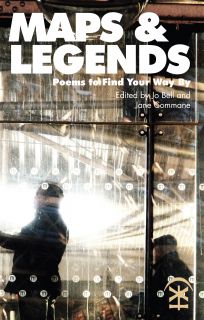
The Book!

Here I am again. The blog seems to be mended and I'm like a child with a new toy. The launch of Maps and Legends - Poems to Find Your Way By, a new anthology published by Nine Arches Press, took place in the new library of Birmingham, earlier this month. The anthology is edited by Jo Bell and Jane Commane and marks the fifth anniversary of Nine Arches Press. 2008 was a very big year for me, I gave birth to my twins and life was never the same. Writing poetry, however, was not at the top of my priorities then, but at the end of 2009 I was beginning to write and had also just heard of a local  Midlands publisher named Nine Arches Press. A few years later and they'd published my first book and my reading - and thus my life - had been dramatically enriched by various Nine Arches publications and poets. This also included setting up the regular Shindig events in Leicester, which has meant bringing lots of fabulous poets to the Midlands and regular contact with Jane Commane. Jane has always been extremely modest about her successes with Nine Arches and is to my mind one of the key editors out there in contemporary poetry. There are some very exciting publications from the press to look forward to in 2014, but back to the anthology.
At the launch we were treated to some very fine readings from Nine Arches poets. It was great to hear Angela France's 'Canzone: Cunning' poem, 'Oh, woman / your grin seeded such an itch in my bones' as well as work from Matt Merritt, David Morley, Daniel Sluman, Roz Goddard and Myra Connell. The event was compered by Jo Bell, who many poetry lovers will have heard of and she brought a great deal of energy to proceedings. I have a few poems in the anthology myself, including a certain poem about a certain poet called Larkin. I've been reading the book over the last few weeks and though much of the work is familiar to me, the poems gathered together feel fresh and inventive in the context of the anthology. In addition to the readers listed above there is some great poetry by Claire Crowther, Peter Carpenter, Alistair Noon, Luke Kennard, Tony Williams, really I could go on. Obviously I'd recommend this book, but if you're interested in contemporary poetry you will not be disappointed! Oh yes and details of how to get hold of the book are available here.

L-R Roz Goddard, Angela France, Deborah Tyler-Bennett, Myra Connell, Jane, Commane, Matt Merritt, Jo Bell, Daniel Sluman and yours truly.


Bingo!

'I've seen the future '
Josephine Corcoran

I've had a few problems with the blog of late, there have been some Malware warnings coming up on screen. Fingers crossed you're able to read this now and the problems been sorted. Back to poetry... or more specifically poetry bingo. In the summer I put together a light-hearted bingo card of words and concepts which I noticed were cropping a lot in the poems I was reading. These words were mainly gathered from magazines and all of them were from contemporary sources. I shared one as a bit of fun with Helena Nelson and she decided to print them as a set, published HappenStance press! They soon became a set of four cards. The cards are an avant garde poem, bingo card, and postcard in one, they also look rather nice on a wall!  Here's a brief explanation from the HappenStance website explaining what the cards are about:

The set of four different cards can also fulfil a useful slot in terms of entertaining postcards for poetry friends. A5 in size, they contain the key words on the back as well as plenty of space to scribble messages, poems or aphorisms.

The bingo cards are available for purchase on the site, so click here to have a look.  A little eccentricity does you good!
Moi and cards...

Wednesday, 27 November 2013

Joel Lane 1963 - 2013

I was very upset to hear of Joel Lane’s passing last night. He was a terrific writer. I know his poetry better than his prose and perhaps in time I’ll read more of his fiction. He’d won major awards as a Fantasy writer and that just goes to show his remarkable scope. Joel was a contributor to Overheard, Stories to Read Aloud published by Salt and edited by my husband Jonathan Taylor. There is a very moving post here by Jane Commane about Joel and his writings on the Midlands.

Joel had a very unassuming presence as a poet, even though he was extremely good at writing poetry. He seemed to shy away from the limelight. We once spoke briefly about him putting together a new poetry collection. He told me he wanted to but he felt a little disconnected from the poetry world. That was about a year ago. Many thanks then to Flarestack for publishing his final pamphlet of poetry, Instinct, a beautiful book I’d strongly recommend.  I’m including the poem below as an example of his ability to marry clarity and evocation so distinctively. I had tears in my eyes as I was typing this up.

Ghosts of the Living

After a day of bruised silence
you finally answered the phone
in a child’s voice. That night
your blank side came to my house

and stood on the doorstep, thin
and trembling, unable to hold on
to yourself. It took me an hour
to bring colour back to your face.

In the morning you left your shadow
pinned to my bedroom wall:
another still for me to run through
the projector of broken sleep.

Sunday, 17 November 2013

Catching up....

Hi, it's been a long while I know. Can't believe my last entry was back in August. It's been a little overwhelming for me both home and work wise, but I'm trying to remedy things. Some poetry related highlights over the last few months have included attending some excellent readings by Jo Shapcott and Cherry Smyth, as well as being in the audience for Nine Arches Press's first 'Poet-tea' reading in Leicester. Also managed to catch a couple of writing days at The Poetry Business in Sheffield. Other than that it's been EDITING! Yes, EDITING! This hasn't been easy. Over the last two or so years, (I started wrapping up the Melanchrini manuscript around December 2011), I've written nearly 70 or so (maybe more, hard to tell in a way) poems and come to the conclusion that only around 25 of those are acceptable. That seems low in a way, but I'm getting very fussy. Some poems will need redrafting, some are just sketches and some are not worth reviving. There is a poem cemetery in my hard drive, many poetic corpses are lying around in unmarked graves. I think most poets like to think about new pieces, but I've wondered about those other 'abandoned'  poems and what their value was and still might be. Maybe their value was to write other poems alongside them where the original intent was actually realised. I've sent out a lot of 'not ready' poems as well as 'ready' ones and it's only time that makes your realise that. The moral is perhaps to hold on or to get decent feedback.

Anyhow, I have a reading coming up in Beeston! Here's a fabulous poster designed by Pippa Hennessy:

I am reading with John Gallas and Roy Marshall. Readers of this blog will know my high opinion of Roy's work and I'm also looking forward forward to hearing more of John's work. Roy Marshall has an EXCELLENT new collection out now with Shoestring, The Sun Bathers. I hope to write more on this very soon and include a poem from the book. It's wonderful that Roy's work is being so well-received in the press at the moment. His Crystal pamphlet Gopagilla has just been reviewed in The TLS alongside other great pamphlets by Kim Moore, Suzannah Evans, Ian Parks, David Clarke and others.

Come and join us in Beeston!

I will try and keep-up-to-date with this blog promise.

Saturday, 31 August 2013

A Few Words on Seamus Heaney

It's been just over a day now since we learnt of Heaney's death. In place of flowers, social networks are full of tweets and updates featuring quotations and indeed whole poems written by Heaney. Some people are sharing anecdotes about him, creating vivid impressions of the man. There was one story somewhere about his kindness to a boy before a reading and him later dedicating a poem to his 'young friend' in the audience.

Today I have somehow done my back in a bit, which is a pain as well as painful. Hoping it will go away soon as. On the other hand it means I have some time propped up on pillows, re-reading Heaney's poetry and watching a documentary where he talks about his own poetry and some of the inner conflicts about reconciling the 'lyric' with the 'dramatic'; the need for poetic truth as well as everyday truth. Heaney managed to achieve that balance. His language was hard and real like a mouthful of toffee, yielding sweetness.


Sunday, 25 August 2013

Interviews


Roy Marshall has been posting interviews with poets on his blog. I find that people who write poetry like to find out what other people who write poetry are thinking about poetry. (That's not intended to be a tongue twister by the way).  I know this as a fact because whenever I go to events discussions tend to involve thoughts on poetry shared liberally over pop and wine.

These interviews often bring up some fascinating details about interests, practices and general thoughts on poetry. These interviews have included poets such as Jodie Hollander, Ian Parks, Matt Merritt and Rebecca Bird. There will probably be more. He interviewed moi as well. I talked quite a bit about what advice I would give new poets, influences and some general thoughts on editing, ideas and so on. Why not make yourself a cup of tea, or a glass of red wine or lemonade, and have a read right here.

Sunday, 18 August 2013

What I Read On My Holidays...


Summer is usually reading time. For some it’s writing time, but I seem to do an awful lot of reading in the holidays; sometimes for reviews, sometimes when someone wants me to cast an editorial eye over something and sometimes even for pleasure. As for the writing I’m working on a few things, including the odd commission which I’ll say more about later.

My summer reading kicked off with a novel, John McGregor’s ‘If nobody speaks of remarkable things.’  It was all about an unremarkable street full of apparently unremarkable people, but there was a type of spell cast over all of them by the narrator. The ending especially was particularly gripping, but I probably shouldn’t talk much about that. As a side note, I like the book’s title. I like the way it sounds like an unfinished sentence. Another book to stay with me for a long time I think.


Next was Matt Merritt’s ‘The Elephant Tests.’ Having heard so many out loud, many of the poems felt very familiar, but I think that’s part of the skill of Matt’s work. The tone is familiar, almost confiding, but then the poet slips in a line, word or image which surprises and engages. There were some fabulous poems, including a longer one called ‘Ravens, Newborough Warren’ which appealed to me for its repeated line, ‘don’t be surprised if nothing happens.’ There were so many poems I could talk about but you can find out more here on the Nine Arches Press website. Earlier in the year we read together in Leeds and I was struck by the way Matt’s work really connects with an audience and heartened to see lots of books sold and going to good homes.

I’m including a poem from the book on the blog. It’s called ‘Azul.’ Considering I was abroad visiting my family as the time of reading, there was something in the vividness of the images that made me look up the skies and consider the ‘inadequacy’ of the words for blue. Ironic perhaps, there’s so much vitality in Matt’s presentation of the colour:

Azul

The sky high and no limit at all.
Each time, the mind’s migration. Sky-blue
sky. Enough to understand
You live on an island. The distance

At once turquoise, cobalt, cyan. Blue
As eyes exactly açor-blue. Shades of the hawk,
Caught on its amphetamine rush against
A sea-blue sea. Caldeira-blue, hydrangea blue,

And the lights coming on
on ships in the harbor.
A navy-blue, and now the night,
Lunar-blue, celeste-blue, shot through

with silver-blue star wounds
that will only heal to a horizon
blue with mountains behind heat haze
or slipping in and out of cloud, like

The piecing together of dreams,
Like realising there are other
islands, and the inadequacy
of the word for blue.

I took a few Happenstance pamphlets with me as well. Recently, I've been reading quite a lot from the press. Fiona Moore’s ‘The Only Reason for Time’ is a pamphlet I’d really recommend, I've been re-reading many of the poems. Many of them deal with the loss of a partner and this is done in a way which is moving, incisive and elegant. The pamphlet initially sold out, but I'm happy to report it's back in stock and be ordered here, so do get hold of a copy before they sell out again. Here's a remarkable poem from the collection called 'The Shirt.' In earlier drafts of this entry I included a link to the poem, but I've found that the site didn't always work on my computer, so I've typed it up: 

The Shirt

I didn't find it for months, your shirt
bundled into a corner of the airing cupboard.
I shook it out. It had been cut
with long cuts, all the way up the sleeves
and up the front, so it looked like a plan
of something about to be put together.
They must have had to work so fast to 
save you there was no time to unbutton it.
An office shirt, because that's where 
it happened. The thin stripes slashed through - 
terrifying, unprecedented - a reminder
of everything I wanted to forget.
I'd washed it afterwards, not knowing what to do
with it, or that in three weeks the same thing 
would happen to another shirt, a favourite,
dull cotton whose thick weave made it look 
as if all the pink shell-grains of sand 
had come together on one beach, 
a shirt for a gentle hug; and from on,
nothing happened that we would forget.

Another special and very different pamphlet was Mark Halliday’s ‘No Panic Here.’ It was recommended to me and I finally found out that the quirky, conversational poetry I’m often drawn to has a name, it’s called ‘ultra talk,’ a phrase Halliday coined himself. It’s quite different in style to a lot of things you’d find in magazines. One bright, peachy Cypriot morning, before anyone else was up, I opened up the pamphlet and this was the first poem I read:

Numerous Swans

So many brooding swans like floating inkstains on a lake of
slender wakefulness. Really a lot, like more than fifty.
Across the narrow hips of the lake they glide,
dark and darkling, their plumes so silent yet not at all sleepy

Nor is the lake itself sleepy; it is a body of water
deep and liquid with liquidity of apprehension
as I turn my phrase like a dinghy and the oars clack
in the melancholy oarlocks. Ah there they pass again,

so many, I had not figured th’ineffable had bred so many,
possibly as many as sixty, swans the inky colour of night,
they are my thoughts if you haven’t twigged to that already,
and I delight to see them there, slender and brooding

and feathery and light and pensive and dark upon the lake of moi.

Mark Halliday 

Click here for more info about the poet himself and the pamphlet from Happenstance.


I like what this poem does and the humour achieved with the swans that become more numerous in the final stanza. The repetitions and images satisfied. The poem offers a way of stepping out of a poem, in the same way you might watch an old cartoon and Bugs Bunny may have stepped out the frame and be talking directly to the audience. Another way of putting this, I suppose may be Brechtian, but that's an overused term. On the other hand, poetry as theatre? Something to think about.

It's still August, there's still more reading to be done. I've got a few review copies to get stuck into. There's also the magazines of course, the most recent issues of 'Under the Radar' and 'The North' have been top reading material. I'm also open to any other recommendations.

Sunday, 7 July 2013

'Whistle' - Martin Figura


On Friday, took a trip into Beeston for a performance of 'Whistle' by Martin Figura. This was part of the Beeston Poets series at the library. The ingredients of the show consist of a poet, a backdrop of images and brief recordings of a mother's voice. Sounds straightforward, but the results are mesmeric.

When Martin was a boy, his father murdered his mother. That much I knew about the show's content, but the story didn't begin there. Martin describes how his parents met and married, had three children and were a seemingly 'normal' happy family. That was especially moving as you knew where the story was heading. It's not just the story though which makes the performance so individual, the show is delivered with some sharp poetry and carefully arranged images. Not just still photographs, but images which speak to the audience and establish a type of dialogue with the poems themselves. In the Q&A after the show Martin explained how photographs are like poems, which I'm inclined to agree with both in this context and in the wider sense. The narration was so smooth that when I picked up the copy of the book after the show I was surprised to see a collection of individual poems, almost thought at times I was hearing an extended poem.

The delivery was quite something. Most poets read poems with brief (or not so brief) introductions. They 'um' and 'erm' a lot, some can even be quite apologetic about their work. Martin's poetry was delivered with pure conviction, nothing was explained, everything was there in the verse. As a performer there was something trance-like about this, it felt almost like a spell was being cast over the audience. When the show finished everyone needed a few moments to come-to. There was a brief interval and then the Q&A which I've mentioned, and there were lots of questions, such was the interest in the work. 

There are some clips here, and do take a look. Finishing though with a clip of 'Vineyard Boys' a poem about the Vineyard children's home to which Martin was sent. I love the way the children are described in a way which is moving and yet unsentimental.